Battle of Klushino 1610: Polish Winged Hussars Against the Odds
The Battle of Klushino: When Polish Winged Hussars Made History
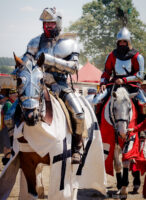
The image captures a magnificent Polish Winged Hussar during a historical reenactment of the Battle of Klushino. This elite cavalry soldier is adorned in authentic period armor featuring the iconic feathered wings, a metal helmet, and gleaming breastplate complemented by a striking red tunic. The hussar rides a powerful brown horse equipped with ornate military tack, while a leopard skin drapes across his mount – a status symbol of these legendary warriors.
The Historic Battle of 1610
The Battle of Klushino stands as one of the most remarkable military engagements in European history. On July 4, 1610, approximately 7,000 Polish-Lithuanian Commonwealth troops faced a massive Russian army of around 30,000 soldiers. Despite being heavily outnumbered, the Polish forces achieved a stunning victory that showcased their tactical brilliance.
Standard historical accounts often state that the Polish Lithuanian striking force at Klushino included 5,556 winged hussars, a figure repeated in widely cited summaries of the battle. At the same time, more recent analysis has questioned whether that number reflects the actual force engaged at Klushino rather than a later payroll based calculation. For that reason, it is safest to say that the battle is commonly associated with about 5,556 Polish hussars, while the exact number remains debated by historians. See the detailed discussion at the Museum of King Jan III’s Palace at Wilanow, as well as summaries in Polityka and Polska Zbrojna.
At the Battle of Klushino, discipline, timing and repeated cavalry charges mattered more than raw numbers. The battle began around 3 AM when Russian sentries at Prieczistoje village spotted the approaching Polish column. The Polish forces, led by Grand Crown Hetman Stanisław Żółkiewski, had marched from Smolensk a month earlier to confront the Russian army in open field. After an all-night march through muddy roads, the Poles discovered the Russian camp in chaos.
Images selection: Editorial photos / Klushino , random order


© All Photos by PLRANG / Imagerion – All Rights Reserved
What made this victory particularly impressive was the condition of the Russian forces. The previous day, confident that battle wouldn’t come soon, Russian soldiers had indulged in food and vodka late into the evening. When Żółkiewski’s forces arrived, many Russian soldiers were still asleep – unclothed and unarmed. Their commanders had to make superhuman efforts to wake the drunken soldiers and force them into position.
The Legendary Winged Hussars
The Battle of Klushino is remembered above all for the performance of the Polish Winged Hussars As depicted in our high-quality historical reenactment photographs, they were the elite heavy cavalry that played a decisive role in this battle. Their distinctive appearance – featuring the famous “wings” made of wooden frames with attached feathers – created both a psychological impact on enemies and a practical function during combat.
These warriors, wearing ornate armor and carrying long lances, performed multiple charges during the battle. As Samuel Maskiewicz, a participant in the battle, recorded, his unit charged eight to ten times despite exhaustion and damaged armor. These relentless attacks eventually broke the enemy’s resistance.
Our detailed photographs showcase the authentic equipment of these remarkable soldiers, from their distinctive helmets to their curved sabers and decorative armor elements that combined protection with noble status symbols.
The Aftermath and Legacy
The Battle of Klushino changed the political balance of the region and opened the road toward Moscow. Following this defeat, Tsar Vasily Shuysky was overthrown by the boyars, and Polish troops entered the Russian capital. The boyars even declared the Polish prince Władysław as the new tsar.
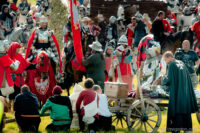
Historical reenactments like the one featured in our photography collection allow modern viewers to experience the magnificence of the Polish Winged Hussars. These events meticulously recreate the military formations, weapons, and camp life of soldiers from the early 17th century.
These living history demonstrations serve as powerful reminders of a time when the Polish-Lithuanian Commonwealth was a military powerhouse in Eastern Europe, and the Polish Winged Hussars were feared on battlefields throughout the region.
Today, the Battle of Klushino remains one of the clearest examples of how training, morale and tactical execution could overturn a massive numerical disadvantage.